

You want the truth about data analytics jobs right now. Not the polished version. Not the “follow your passion” pep talk. The raw, unfiltered reality.
I spent six years in this field. I built dashboards. I wrote SQL queries at 2 a.m. I explained p-values to executives who thought they were stock tickers. I got laid off in January. I applied to 100+ jobs. I got two callbacks.
That is not an outlier. That is the norm.
This post is not here to scare you. It is here to reset your expectations. If you are planning to enter this field, or if you are already in it and wondering why nothing is working, read this. Then act.
The job market for entry-level data analysts is broken. Not slow. Not challenging. Broken.

Companies want someone with 2-3 years of experience for roles labeled “entry level.” They want Python, SQL, Tableau, Power BI, R, Excel, and domain knowledge—all before you even sit down for an interview. They want you to have solved real business problems, but they will not give you the chance to do so unless you already have done them.
Here’s what most people miss. The problem is not your skills. The problem is the supply-demand imbalance. Too many people entered this field during the pandemic boom. Bootcamps churned out graduates by the thousands. Companies hired aggressively. Now, those same companies are cutting costs. They are not hiring juniors. They are hiring people who can hit the ground running. Or they are not hiring at all.
A friend of mine, let’s call her Priya, graduated from a top-tier university with a degree in economics. She took online courses in SQL and Python. She built three portfolio projects. She applied to 80 jobs. She got one interview. She did not get the job.
Another friend, John, has five years of experience as a business analyst. He switched to data analytics two years ago. He applied to 60 roles. He got four interviews. He got zero offers.
These are not exceptions. These are the rules.
Remote jobs? Forget it. Unless you are already employed at a major tech company, remote roles are nearly impossible to land. Companies prefer local candidates. They want someone they can bring into the office. They want someone who understands their specific industry context. They want someone who can walk into a meeting and immediately contribute.
Location matters more than you think. If you live in a state with high unemployment or low tech presence, your odds drop further. Some companies will not even consider applicants outside certain regions. They do not say this upfront. You find out after submitting your application and never hearing back.
On-site jobs are easier. Not easy. Easier. You can network locally. You can attend meetups. You can build relationships. Remote work removes that layer of human connection. It makes you just another resume in a pile.
Your degree does not matter as much as you think. But it still matters.
If you have a degree in computer science, statistics, or data science, you have a slight edge. Not because those degrees teach you better skills. But because hiring managers see them as signals of competence. They assume you understand math. They assume you can code. They assume you are serious.
If you have a degree in marketing, communications, or history, you face an uphill battle. Not because you cannot learn the skills. You can. But you must prove it harder. You must show that you are not just dabbling. You must demonstrate that you can deliver results.
I know someone with a degree in art history. He taught himself SQL and Python. He built a project analyzing museum attendance trends. He landed a job at a nonprofit. His secret? He focused on one industry. He tailored his resume to that industry. He spoke the language of that industry. He showed he understood their pain points.
That is your path. Pick one industry. Learn its jargon. Understand its metrics. Build case studies around its problems. Apply only to companies in that space. Do not spread yourself thin.
Skills alone will not get you hired. You need context.
Yes, you must know SQL. Yes, you must know Python. Yes, you must know how to build a dashboard. But that is the baseline. Everyone knows that. What separates you is your ability to understand the business.
Can you explain why a metric dropped? Can you identify the root cause? Can you recommend a fix? Can you communicate that clearly to non-technical stakeholders?
Most junior candidates fail here. They focus on the tools. They memorize syntax. They build flashy visualizations. But they cannot connect the dots. They cannot tell a story with data.
Here’s what you should do instead. Find a real dataset. Pick a problem. Solve it. Document your process. Explain your findings. Present them like you would in a business meeting. Record yourself doing it. Watch it back. Improve.
Practice until you can explain complex analysis in simple terms. Until you can answer “so what?” without hesitation.
The hiring process is broken. It is designed to filter people out, not find the best fit.
You will be asked to complete take-home assignments. Some take 4-6 hours. Others take 8-10. You will be expected to deliver professional-grade work for free. You will be evaluated on how well you follow instructions, not on the quality of your insights.
Some companies use automated screening tools. They scan your resume for keywords. If you do not have the exact phrase they want, you are rejected. No human ever sees your application.
Others conduct multiple rounds of interviews. Technical screens. Behavioral interviews. Case studies. Panel discussions. Each round eliminates more candidates. By the time you reach the final round, you are competing against people with years of experience.
And even then, you might not get the job. Because the company decided to freeze hiring. Or they found someone internally. Or they changed their mind about the role.
It is exhausting. It is demoralizing. It is normal.
What should you do if you are stuck?
First, stop applying to every job you see. That is a waste of time. Focus on quality over quantity. Target 5-10 companies per week. Research them. Understand their business. Tailor your application to each one.
Second, build a portfolio that tells a story. Not just code snippets. Not just charts. Show how you solved a problem. Show the impact. Show the business value. Use real datasets. Use real scenarios. Make it relevant to the industry you want to enter.
Third, network. Go to local meetups. Join Slack groups. Connect with people on LinkedIn. Ask for advice. Offer help. Build relationships. Most jobs come through referrals. Not applications.
Fourth, consider adjacent roles. Business analyst. Marketing analyst. Operations analyst. Product analyst. These roles often require similar skills. They may have less competition. They may be easier to break into. Once you are inside, you can pivot.
Fifth, keep your current job if you have one. Do not quit until you have an offer. The job search takes time. It takes persistence. It takes resilience. Quitting early puts you in a weaker position.
AI is changing the game. Fast.
Companies are using AI to automate routine tasks. Cleaning data. Generating reports. Building basic dashboards. Writing simple queries. This means fewer entry-level roles. Fewer opportunities for juniors to learn on the job.
But AI is not replacing analysts. It is changing what analysts do. You must adapt. Learn how to use AI tools. Understand their limitations. Know when to trust them and when to question them.
You must become a critical thinker. A problem solver. A communicator. Skills that AI cannot replicate.
For instance, I worked with a team that used AI to generate customer segmentation models. The AI produced five segments. The team reviewed them. Found one segment made no sense. Dug deeper. Discovered a data quality issue. Fixed it. Improved the model.
That is the future. Working with AI, not being replaced by it.
Salary expectations need adjustment.
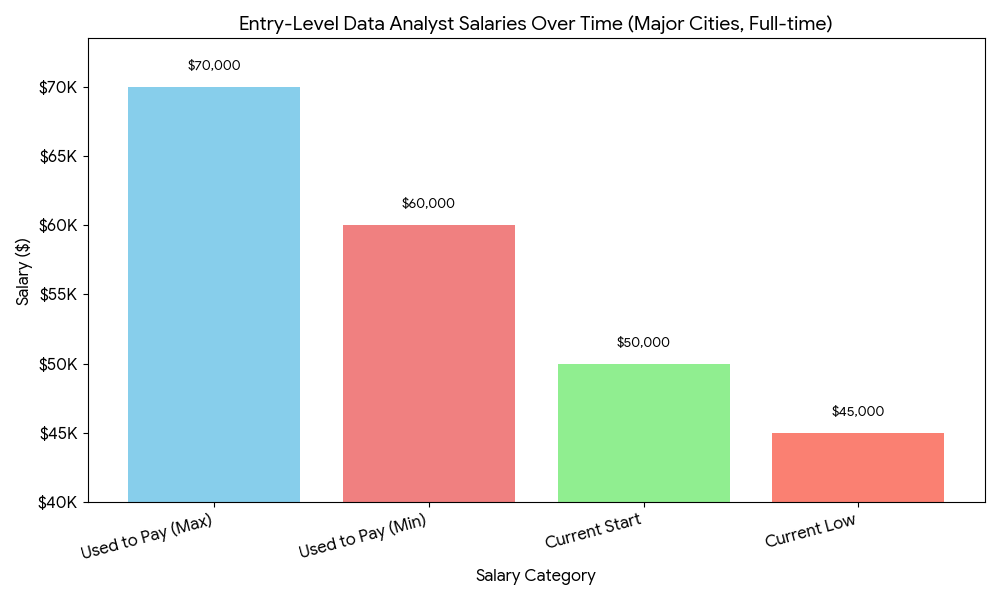
Entry-level data analyst roles used to pay $60,000-$70,000 in major cities. Now, many start at $50,000. Some go as low as $45,000. And that is for full-time positions. Contract roles pay less. Remote roles pay less.
Do not expect to make six figures right away. That is not realistic. Focus on gaining experience first. Build your skills. Prove your value. Then negotiate.
If you are offered a salary below market rate, ask why. Ask what the growth path looks like. Ask about training opportunities. If they cannot answer, walk away.
Certifications? They help, but only if you use them right.
Google Data Analytics Certificate. IBM Data Analyst Professional Certificate. Microsoft Certified: Data Analyst Associate. These are not magic bullets. They do not guarantee a job. But they can open doors.
Use them to fill gaps in your knowledge. Use them to show commitment. Use them to build projects. Do not treat them as checkmarks. Treat them as learning tools.
I completed the Google certificate. I used it to build a project analyzing e-commerce sales. I presented it to a hiring manager. It got me an interview. The certificate itself did not get me the job. The project did.
Interviews are not about showing off. They are about showing you can solve problems.
You will be asked technical questions. Write a query to find the top 5 customers by revenue. Calculate the average order value. Clean a messy dataset.
You will be asked behavioral questions. Tell me about a time you faced a challenge. How did you handle it? What did you learn?
You will be asked case study questions. How would you measure the success of a new feature? How would you diagnose a drop in conversion rate?
Prepare for all three. Practice out loud. Record yourself. Get feedback. Improve.
But do not memorize answers. Think on your feet. Ask clarifying questions. Walk through your thought process. Show how you approach problems.
Hiring managers care more about your thinking than your final answer.
Your resume must stand out. In a good way.
Do not list every tool you have touched. Do not write generic statements like “detail-oriented team player.” Be specific. Be measurable. Be results-driven.
Instead of “Used SQL to analyze data,” write “Wrote SQL queries to identify $50,000 in cost savings by optimizing inventory levels.”
Instead of “Built dashboards in Tableau,” write “Created interactive Tableau dashboard that reduced reporting time by 70% for marketing team.”
Quantify everything. Use numbers. Show impact. Make it clear what you did and why it mattered.
Cover letters are dead. Except when they are not.
Most companies do not read them. But some do. If you are applying to a smaller company or a startup, write a short, personalized cover letter. Mention something specific about the company. Show that you have done your homework.
Keep it under 200 words. One paragraph. Direct. Clear. To the point.
Do not rehash your resume. Do not flatter the company. Do not write a novel. Just explain why you are interested and what you can bring.
LinkedIn is your best friend. Use it properly.
Optimize your profile. Use keywords. Add projects. Post regularly. Engage with others. Comment on posts. Share insights. Build your personal brand.
Do not just collect connections. Build relationships. Reach out to people. Ask for advice. Offer help. Be genuine.
I got my last job through a LinkedIn connection. We had never met. I commented on his post. He replied. We started chatting. He referred me. I got the job.
That is how it works. Slowly. Consistently. Authentically.
Freelancing can be a lifeline.
Upwork. Fiverr. Toptal. These platforms allow you to take on small projects. Build your portfolio. Gain experience. Earn money.
Start small. Charge low rates at first. Deliver high-quality work. Get reviews. Increase your rates.
Use freelancing to fill gaps in your resume. To gain exposure to different industries. To build confidence.
It is not ideal. But it is better than sitting idle.
Internships are hard to find. But not impossible.
Many companies offer paid internships. Some offer unpaid. Both can lead to full-time roles. Especially if you perform well.
Apply early. Target companies that have a history of hiring interns. Network with current employees. Ask for referrals.
Treat internships like full-time jobs. Show up. Work hard. Ask questions. Take initiative. Make yourself indispensable.
The biggest mistake people make? They give up too soon.
The job search takes time. Months. Sometimes years. You will face rejection. You will feel discouraged. You will doubt yourself.
That is normal. Everyone feels that way. The difference between those who succeed and those who don’t is persistence.
Keep applying. Keep learning. Keep improving. Keep networking. Keep building.
Do not compare yourself to others. Your path is unique. Your timeline is yours.
What if you are older? What if you are switching careers?
Age is not a barrier. Career switches are common. But you must address it head-on.
In your resume, highlight transferable skills. Problem-solving. Communication. Project management. Analytical thinking.
In interviews, explain why you are making the switch. Show passion. Show preparation. Show results.
I know a 45-year-old former teacher who became a data analyst. He leveraged his teaching experience to explain complex concepts simply. He got hired because he could communicate insights effectively.
Your past is not a liability. It is an asset. If you frame it right.
What if you have no degree?
It is harder. Not impossible. You must compensate with stronger proof of skill.
Build a robust portfolio. Contribute to open-source projects. Write blog posts. Create YouTube videos. Teach others.
Show that you can do the work. Show that you understand the business. Show that you can deliver results.
One candidate I know had no degree. He built a project analyzing NBA player performance. He posted it on GitHub. He shared it on LinkedIn. He got noticed. He got hired.
Your work speaks louder than your degree.
The future of data analytics is not bleak. It is evolving.
Companies still need analysts. They always will. But the role is changing. Less data wrangling. More strategic insight. Less reporting. More decision-making.
You must evolve with it. Learn new tools. Understand new domains. Develop soft skills. Become a business partner, not just a report generator.
The people who thrive are those who adapt. Who learn continuously. Who focus on value, not just output.
Here is your action plan.
- Week 1: Audit your skills. Identify gaps. Choose one industry to focus on.
- Week 2: Build one portfolio project related to that industry. Document your process.
- Week 3: Optimize your resume and LinkedIn profile. Tailor them to your target industry.
- Week 4: Start applying to 5-10 targeted roles. Track your applications. Follow up.
- Week 5: Attend one meetup or event. Connect with three people. Ask for advice.
- Week 6: Complete one certification or course. Use it to build another project.
Repeat. Adjust. Improve.
Do not wait for the perfect moment. Start now. Even if you are not ready. Especially if you are not ready.
Final thought.
This field is not for everyone. It is hard. It is competitive. It is frustrating. But it is also rewarding. When you solve a real problem. When you influence a decision. When you see your work make a difference.
If you are in it for the long haul, you will succeed. Not because you are smarter. Not because you are luckier. Because you are persistent.
Keep going. Keep learning. Keep building.
The market will improve. Opportunities will return. But only if you are ready when they do.

Shubham Gupta is the Founder and Senior AI/LLM Data Scientist at QuantG. With 4.5 years of technical experience engineering advanced machine learning pipelines and large language model architectures, he is dedicated to delivering high-performance, enterprise-grade AI solutions. Under his leadership, QuantG drives technical innovation by building scalable, zero-latency data systems designed for real-world impact. Connect with him on LinkedIn to follow his latest development frameworks.