
| Industry | PropTech / Real Estate Investment |
| Region | Australia |
| Pain | Investors were making $500K–$5M property decisions with a single estimated value and no way to know how much to trust it |
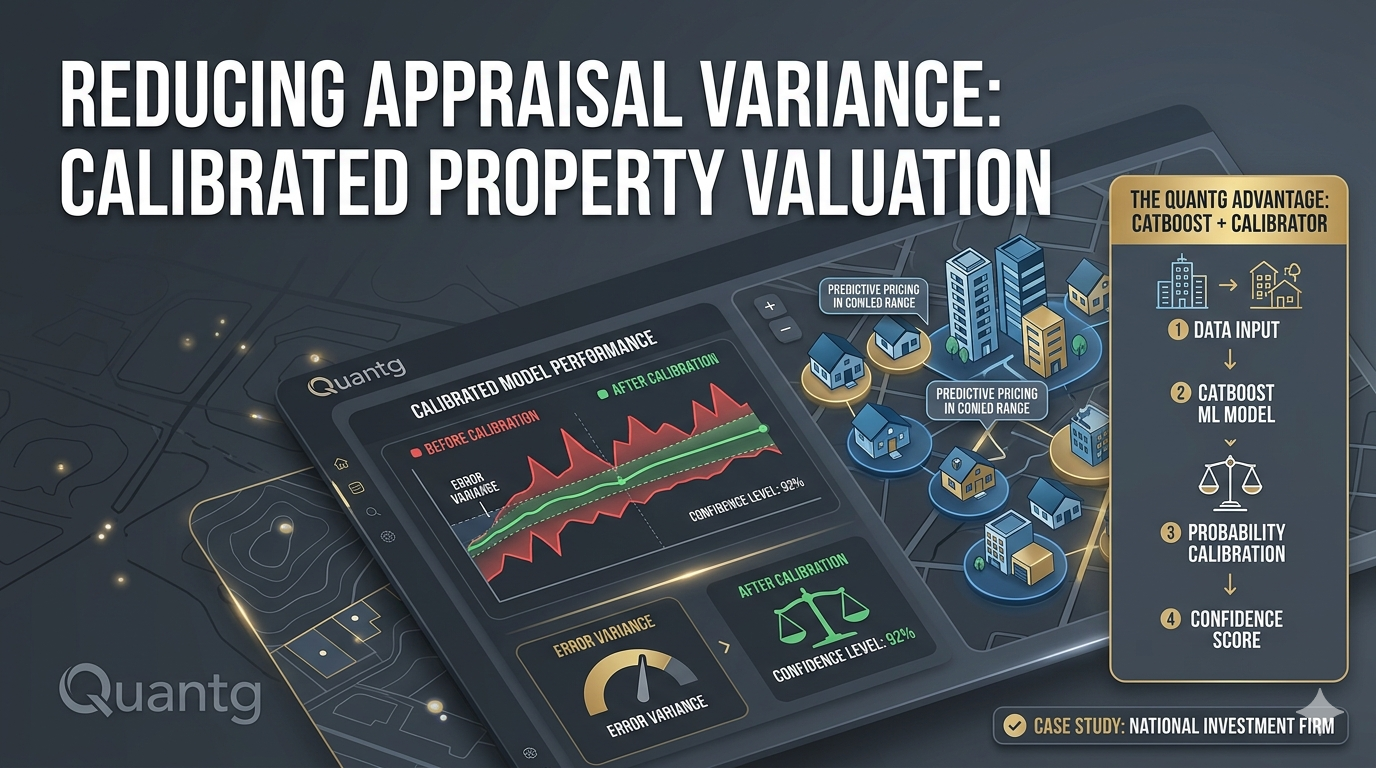
| What we built | A proprietary property valuation intelligence system that outputs a calibrated price range — not just a number |
| Proof | Investors report making offer decisions with a clear floor and ceiling for the first time — rather than anchoring to a single number with no context |
Client
The Client is a Australian firm is making property investment clearer. Their platform takes the guesswork out of investing by providing real-time market info and deep local analysis. The goal is simple: help investors find the best opportunities across Australia based on facts, not speculation.
Pain
Their existing valuation tool had a fundamental flaw shared by most AVM products on the market: it gave investors one number and nothing else.
For someone committing $500,000 to $5 million on a property, a single estimate with no confidence context is barely better than a guess. Is this valuation rock solid or is it based on three comparable sales from 18 months ago in a suburb with very different conditions today? The number looks the same either way.
The result was predictable. Investors were overpaying on properties the market had already moved past, and underselling assets that had more room than the estimate suggested. Trust in the platform was eroding — not because the data was wrong, but because it gave no signal of how right it was.
There was a second problem. The client didn’t want a model trained once and left to go stale. Property markets move with employment data, migration flows, and economic shifts. They needed a system that stayed current — one that captured how market conditions change over time, not just how properties compare to each other today.
Solution
Most property valuation tools look at the obvious — bedroom count, location, recent sales. We started there too, but quickly realised the bigger story was in the signals most tools ignore.
Employment shifts in a suburb. Migration patterns into a region. Crime rate trends. Rental yield movements. These factors don’t show up on a property listing, but they quietly drive where prices go next. Our analysis of the client’s Australia-wide sales data confirmed this — the indirect signals were often more predictive than the property specs themselves.
We built a prediction model trained on this fuller picture of the market. But a single predicted number still has a problem — it hides how confident the model actually is. A property in a stable, high-transaction suburb and a property in a thin, volatile market might both get a valuation of $850,000, but the certainty behind those two numbers is completely different.
So we added a confidence layer on top of the prediction. Every valuation now comes back as three numbers — a low, an estimate, and a high. The spread between them tells the investor something a single number never could: how much uncertainty is baked into this particular property, in this particular market, right now.
For an investor, that changes the decision entirely. Instead of anchoring to one figure and hoping it’s right, they now have a range they can negotiate within — and a clear signal of when a market is too unpredictable to price confidently.
Result
The model delivers property valuations with a Mean Absolute Error of 8–12% against a market standard of 15% — reducing valuation error by up to $140,000 on a $2M property decision.
Every valuation outputs three values — a low, an estimate, and a high — giving investors a negotiation range rather than a single anchor. The spread itself communicates confidence: a narrow band signals a stable, well-understood market. A wide band signals volatility and flags the investor to tread carefully.
The model retrains on new data continuously, meaning valuations reflect current employment trends, migration patterns, and rental conditions — not a static snapshot from the last training run.

Shubham Gupta is the Founder and Senior AI/LLM Data Scientist at QuantG. With 4.5 years of technical experience engineering advanced machine learning pipelines and large language model architectures, he is dedicated to delivering high-performance, enterprise-grade AI solutions. Under his leadership, QuantG drives technical innovation by building scalable, zero-latency data systems designed for real-world impact. Connect with him on LinkedIn to follow his latest development frameworks.