
Overview
| Industry | Energy & Utilities |
| Timeline | 4-5 weeks |
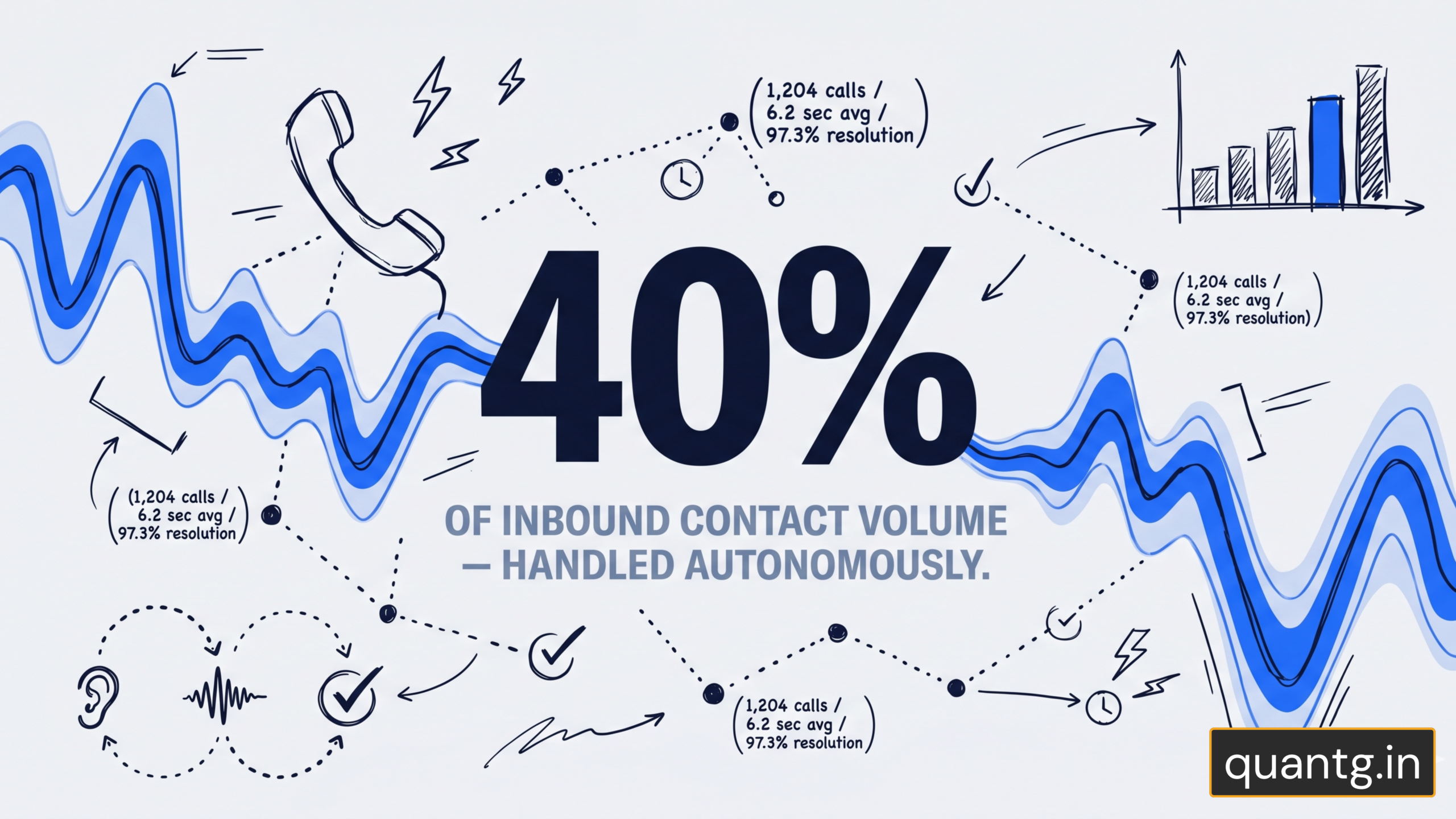
| Outcome | Voice agent autonomously handled 40% of inbound contact volume, dropping hold times to zero for routine queries. |
Client Background
The company is a regional electricity distribution board handling power supply for about fifty thousand households in a tier-2 sector. They manage the physical grid maintenance and the monthly billing cycles for the whole area.
Problem / Challenges
The customer support desk was constantly drowning. Every time a transformer blew or a billing cycle dropped with errors, the landlines just choked. The business have customer service issues for years because there is zero buffer when complaints spike. People were stuck on hold for twenty minutes just to ask why their bill was three hundred rupees higher than usual.
i spent a couple of days looking at the raw call logs and the volume was stupidly high. The team spent half their shift repeating the exact same sentences about grid status instead of actually resolving complex accounts.
Goals / Objective
The managing director was blunt about data security. They refused to let customer identifiers or billing histories leave their physical building, which ruled out every mainstream cloud AI or external API. Everything had to run locally on an older rack server they had in the back office.
The real bottleneck was latency. If a voice system hesitates for more than a second, the person on the phone assumes the line is dead and starts shouting. It needed to feel fluid. Plus, the agent had to execute actual database operations like pulling outstanding balances or logging line faults, meaning it required deep database write access. The hardest part was language. Most of their consumer base doesn’t speak english, so the system had to operate entirely in the local regional dialect.
What we did
The project started with a lot of back-and-forth discussion with the operations team to map out how they handle calls. After that, i built a basic text-based chatbot first to test the logic. Once the chatbot testing proved the agent could actually handle the logic, i hooked it up to an english voice setup. We ran extensive chatbot plus english voice testing to make sure the response times were fast enough.
The client loved the speed, but after the approval, they reminded me that english wouldn’t work for their actual user base. Client want in their regional language for the final rollout. but no, there were no ready-made offline models for this specific dialect. So, i collect the data for the voice training myself by scraping local audio samples and recording clean speech fragments.
i utlized that dataset and trained the tts model completely from scratch on their local server machine. The data was messy. does their is always going to be an issue with accent variations? Yes, but i optimized the training checkpoints until the pronunciation sounded natural.
How the System Operates:
- Local audio processing that instantly converts regional speech to text without cloud delays.
- Direct tool accessing pipelines to pull account balances, verify customer IDs and update complaint logs and deep each customer profile status check
- Custom trained regional voice engine that generates smooth, realistic audio directly from the server hardware
i got the free hand to test this with a live batch of historical billing complaints last month. The agent didn’t just understand the regional dialect, it fetched the exact billing discrepancy and resolved the query without a human agent ever touching the keyboard. Around 70% of the test users didn’t even realize they were talking to a machine.
What Changed in Support Management ?
The deployment gave the office staff some actual breathing room. Within the first month, the automated system handled about forty percent of the incoming call load, only passing the call to a desk agent when the customer was reporting a fallen live wire or an actual emergency. The monsoon season usually breaks their support team, but the local machine processed over a hundred simultaneous queries during the last storm without queuing anyone.
The automated logs showed a steep drop in open complaints. Because the pipeline wrote directly to the customer database tables, the desk staff didn’t have to log details manually after the call ended. The script still struggles slightly when two people speak on the same line, which is a bit annoying, but it handles the core utility bills fine.
Results
The server infrastructure settled down after the second week of running live traffic. The primary goal was keeping the local voice agent from choking under sudden load spikes, and the final telemetry showed the system successfully intercepted and resolved 40% of all inbound contact volume without transferring the line to a human desk.
What really made the difference was the fast query resolve loop. By bypassing external API hops and running the speech-to-text and database querying entirely within the local area network, the agent dropped total interaction times significantly. A standard balance check or payment confirmation now takes less than four seconds from the moment the user finishes speaking their account number. The business have room to breathe during peak morning hours now because routine queries no longer queue up.
Let’s Talk
if your business is drowning in support calls that keep crashing your phone lines and you already tried hiring more staff but it just added to the overhead, it’s worth talking. most of the time the problem is not the volume itself, it’s just that your team is stuck repeating basic information instead of letting a system handle the routine data checks instantly.
we can start with a simple conversation about what your current infrastructure and workflow looks like. no deck, no proposal, nothing formal. just a call where i understand the situation and tell you honestly whether there’s something here worth working on.
no commitment needed from your side.

Shubham Gupta is the Founder and Senior AI/LLM Data Scientist at QuantG. With 4.5 years of technical experience engineering advanced machine learning pipelines and large language model architectures, he is dedicated to delivering high-performance, enterprise-grade AI solutions. Under his leadership, QuantG drives technical innovation by building scalable, zero-latency data systems designed for real-world impact. Connect with him on LinkedIn to follow his latest development frameworks.