
Overview
| Industry | Import and Export Business |
| Timeline | 4-5 weeks |
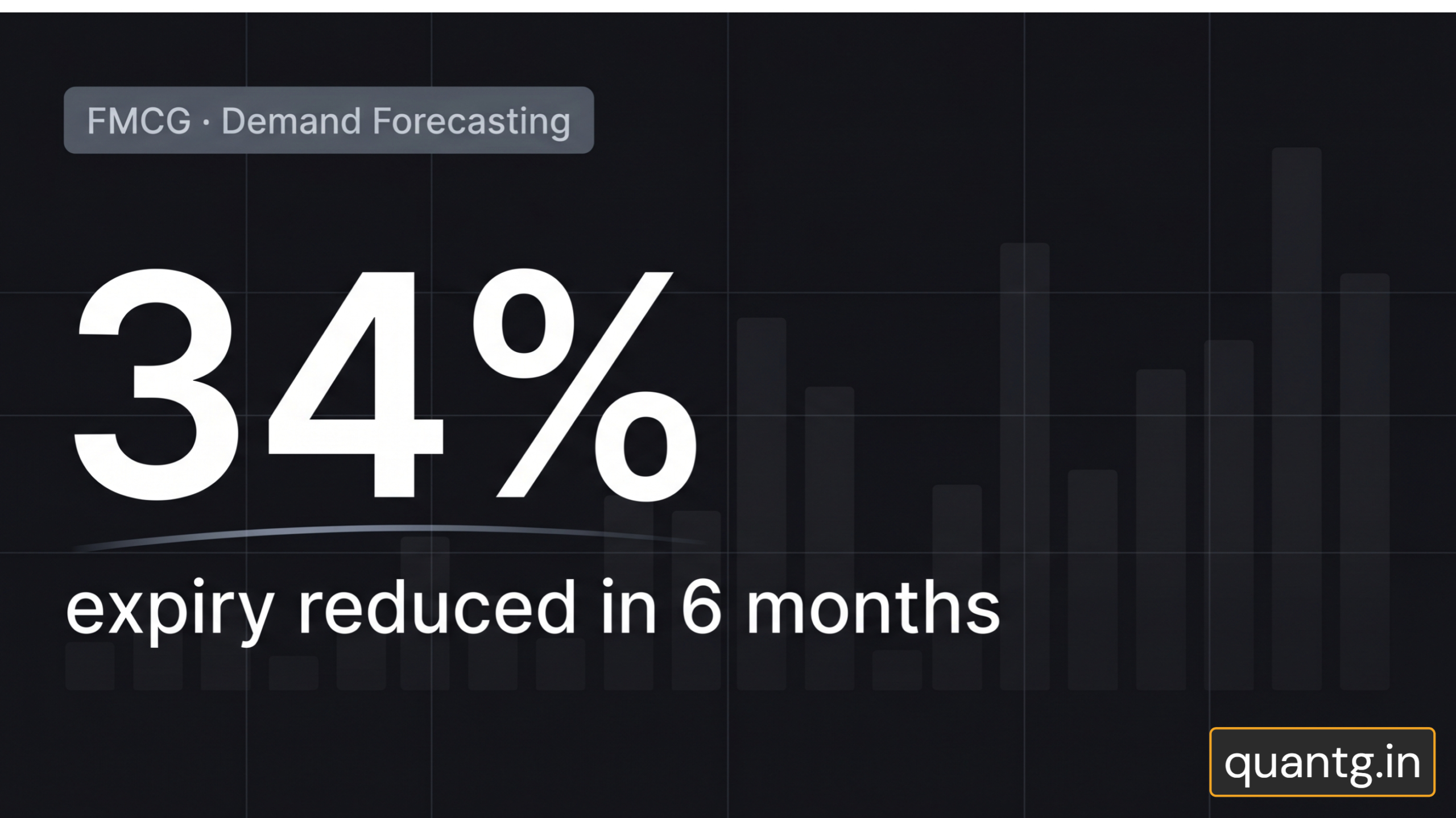
| Outcome | 34% reduction in product expiry within six months |
Client Background
Client is a mid sized FMCG product supplier and exports consumable products to various countries, annual turnover sits around 30 crores. operation is learn, they have small teams to handles everything from supplier to shipment management.
Problem/ Challenges
The business have stock management issue, was carrying more expired stock than it could be explain away as business operational loss. expiry rate of the product raising each year which result in heavily impact on business profit margins.
On the other hand, to avoid the expiry understock seen the solution, but no. Due to this they also lose the some of the partners because no able to meet partners criteria.
As demand, shipments were arriving late , some buyers were going elsewhere, and two distribution partners had stepped back because the business was no longer meeting their minimum fill-rate requirements.
What we did
The first weeks we spent largely on discussion with their team and understanding problems to the roots such as how stock arranged according to season, does their is always a loss making product, and much more. After that, we collect all important data from the team and reading through sales/purchase histories of products. whatever sales records the team could pull together. The data was messy.
The pattern that came out of the first analysis was both obvious in hindsight and genuinely invisible until the data was laid flat. Certain SKUs shows strong numbers of the growth in quarter 4 (Q4) but in Q1 and Q2 demand reduced by 75$-%80%. but the stock were over ordered based on Q4 results. Demand of the certain SKUs are totally different and seasonal. this overstock sitting in the self, till they expires.
Based on the findings, I created solution. deep analysis dashboard, demand forecasting and sales forecasting and deep each SKUs detail report. Then, I sat with the supply chain manager of business and walk through the what we found with the what would the best solution possible. Manager finally seeing the patterns and how the problem would be tackled. after getting the greenlight from him, I started working on the project.
For the BI dashboard, I go with the same software that they teams were using for data dashboards. but in forecasting, i got the free hand, i didn’t go with traditional forecasting way, as they are outdated and not much reliable. i utlized more robust and powerful way to make the forecasting and built that personalized forecasting dashboard.
I also built a multi page report on each SKUs and explain each SKUs their seasonal demands, forecasting, past data patterns and future demand.
What Changed in the Warehouse
The first visible change was in how the internal discussions happened. Before, stockout discussions happened after a shortage was already confirmed. After two months, noticeable changes happening, those discussions started happening four to six weeks earlier, while there was still time to do something about it.
Purchasing management started ordering from our suppliers sooner to give them more time, which in several cases got them better pricing and better allocation priority.
On the dead stock side, the warehouse team began acting on the risk view quickly once they trusted it. few slow selling SKUs batches were offered to market buyers at a small discount before they get expired. Before that hadn’t happened because nobody had a way to identify which SKUs/batches needed attention with enough lead time to make a discount worthwhile rather than desperate.
The Results
After six months, expiry-related losses had dropped by 34%.
That number came from comparing the same categories of stock across the same time period, before and after. It was not a result of selling faster, or discounting more aggressively. It came from buying better and moving stock with enough lead time to actually do something with it.
Some of the reduction in expiry came from simple reallocation like moving stock between locations before it get expired. Some came from better timely orders that reduced how much overstocked in the first place, and some came from conversations with customers who, once called early enough, were happy to pull forward an order they were planning anyway.
To make business successful again, it does not have to require a new supplier relationship or bigger warehouse or a change in how the business operated. It required the right information, arriving at the right time, in a form that the people responsible for decisions could actually use to grow business.
Let’s Talk
if your business is sitting on stock that keeps expiring and you already tried cutting orders but it made things worse, it’s worth talking. most of the time the problem is not the stock, it’s just that no one is seeing the right information at the right time.
we can start with a simple conversation about what your current setup looks like. no deck, no proposal, nothing formal. just a call where i understand the situation and tell you honestly whether there’s something here worth working on.
no commitment needed from your side.

Shubham Gupta is the Founder and Senior AI/LLM Data Scientist at QuantG. With 4.5 years of technical experience engineering advanced machine learning pipelines and large language model architectures, he is dedicated to delivering high-performance, enterprise-grade AI solutions. Under his leadership, QuantG drives technical innovation by building scalable, zero-latency data systems designed for real-world impact. Connect with him on LinkedIn to follow his latest development frameworks.